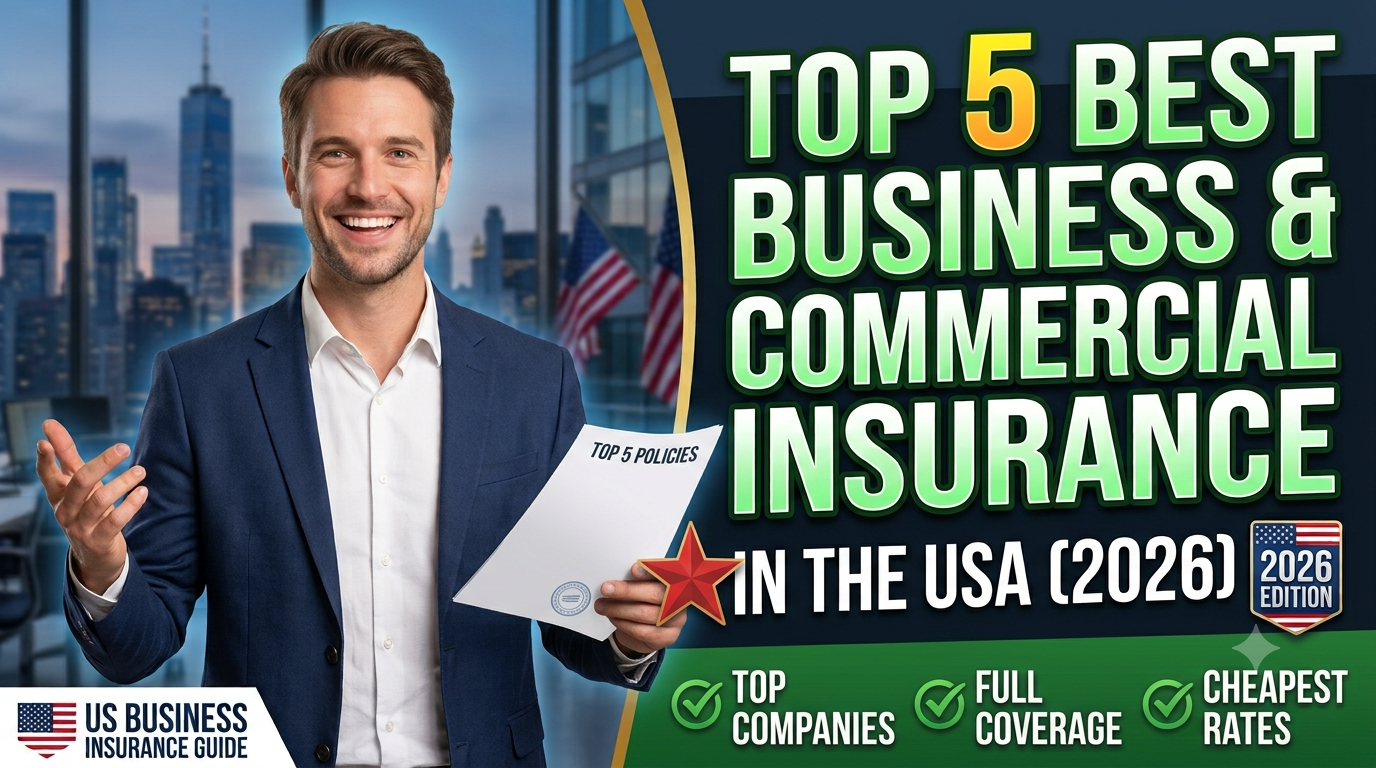
Top 5 Best Business & Commercial Insurance Companies in the USA
Operating a business in today’s landscape brings immense opportunities, but it also carries substantial risks. From slip-and-fall accidents in a retail storefront to devastating cyber breaches and property-damaging natural disasters, a single unforeseen incident can compromise years of hard-earned growth.
This is where commercial insurance (often called business insurance) becomes your most critical asset.
Finding the “best” commercial insurance is not a one-size-fits-all process. The ideal policy depends heavily on your industry, your payroll size, your physical assets, and your risk tolerance. This comprehensive guide breaks down the best commercial insurance companies, the essential coverage types you need, and practical strategies to secure the most protective coverage at the best rates.
1. Quick Overview: Best Commercial Insurance Providers
| Carrier | Best For | Standout Feature | AM Best Financial Rating |
| The Hartford | Best Overall for Small & Mid-Sized Businesses | Industry-specific Business Owner’s Policies (BOP) | A+ (Superior) |
| NEXT Insurance | Best for Fast Digital Quotes & Freelancers | 100% online policy management and rapid certificates | A- (Excellent) |
| Chubb | Best for Large Enterprises & Global Coverage | Unmatched limits and specialized international programs | A++ (Superior) |
| Progressive Commercial | Best for Commercial Auto & Fleets | Largest commercial auto writer in the US with broad options | A+ (Superior) |
| biBERK | Best for Cost-Savings (Direct-to-Business) | No broker fees; part of Berkshire Hathaway | A++ (Superior) |
2. Deep Dive: Top Commercial Insurance Companies
To help you make an informed decision, we evaluated the leading commercial insurance carriers on financial strength, claims-handling reputation, coverage flexibility, and digital ease-of-use.
The Hartford: Best Overall for Small Business
With over 200 years of experience, The Hartford is the gold standard for small to mid-sized business insurance. They specialize in tailoring coverages specifically to the unique nuances of different professions, from local bakeries and medical clinics to IT consultants.
- Primary Strength: Their Business Owner’s Policy (BOP) is highly customizable and seamlessly integrates General Liability, Property, and Business Interruption coverages into one affordable package.
- Why Choose Them: Outstanding customer service and a simplified, highly intuitive claims filing process.
- Best Suited For: Retail stores, professional offices, medical practices, and local service providers.
NEXT Insurance: Best for Startups & 100% Online Experience
NEXT Insurance has revolutionized the commercial insurance market by eliminating complex paperwork. Designed entirely for the modern, digital-first business owner, NEXT allows you to buy, manage, and share your proof of insurance within minutes.
- Primary Strength: Speed and digital convenience. You can instantly generate unlimited digital Certificates of Insurance (COI) via their mobile app, which is a major benefit for contractors who need to prove coverage on-site.
- Why Choose Them: Highly competitive, budget-friendly pricing for solo entrepreneurs, freelancers, and small contractors.
- Best Suited For: Freelancers, independent contractors, personal trainers, and micro-businesses.
Chubb: Best for Large Scale & Global Businesses
Chubb is the world’s largest publicly traded property and casualty insurance company and a premium provider of commercial protection. Chubb caters aggressively to larger operations, high-revenue mid-market businesses, and companies with international footprints.
- Primary Strength: Elite underwriting capability and vast coverage limits. They offer highly sophisticated policies for specialized risks, such as Executive Protection (D&O), Environmental Liability, and Advanced Cyber Loss.
- Why Choose Them: Their financial strength and global reach mean they can handle complex risk structures and settle massive claims smoothly.
- Best Suited For: Exporters, manufacturing plants, technology firms with global users, and high-revenue enterprises.
Progressive Commercial: Best for Commercial Auto & Fleet Management
If your business relies on wheels, Progressive is the undisputed market leader. From single delivery vans and contractor pickup trucks to full-sized tractor-trailers and long-haul freight fleets, Progressive covers a massive spectrum of commercial auto risks.
- Primary Strength: A highly flexible commercial auto program paired with their commercial insurance marketplace, which helps source other business coverages easily.
- Why Choose Them: Excellent specialized claims adjusters who understand down-time costs for commercial vehicles.
- Best Suited For: Trucking companies, delivery services, contractors with work trucks, and companies with employee-driven fleets.
biBERK: Best Budget-Friendly Direct Carrier
biBERK is a direct-to-business insurance company backed by the financial fortress of Warren Buffett’s Berkshire Hathaway. Because they sell directly to businesses without utilizing middleman brokers, they are often able to pass on savings of up to 20% to their customers.
- Primary Strength: Zero broker fees and clear, upfront pricing.
- Why Choose Them: Exceptional financial reliability (backed by Berkshire Hathaway) combined with straight-to-the-point online policy management.
- Best Suited For: Budget-conscious small business owners looking for standard coverages like Workers’ Comp and General Liability.
3. The Core Pillars of Commercial Insurance (What Coverages Do You Need?)
A robust commercial insurance strategy is typically built on several core coverages. Depending on your business model, you might need one, some, or all of these policies:
A. General Liability Insurance (GL)
Often referred to as “slip-and-fall” insurance, General Liability is the foundation of any business safety net.
- What it covers: Bodily injury to non-employees on your premises, accidental damage to someone else’s property, and personal/advertising injuries (like libel or copyright infringement).
- Example: A customer slips on a wet floor inside your boutique, breaks their wrist, and sues for medical costs.
B. Commercial Property Insurance
This policy protects your physical assets from natural disasters, vandalism, theft, and fire.
- What it covers: Your physical building (if you own it), inventory, computers, specialized equipment, furniture, and tools.
- Example: A burst pipe floods your office overnight, ruining your servers, desks, and inventory.
C. Business Owner’s Policy (BOP)
A BOP is a bundled package specifically designed for small businesses. It combines General Liability, Commercial Property, and Business Interruption Insurance into a single, discounted policy.
- Why it’s great: It is far cheaper than buying these policies individually and ensures there are no gaps between your property and liability coverages.
D. Professional Liability Insurance (Errors & Omissions / E&O)
If your business provides advice, designs, or professional services, General Liability will not protect you from mistakes. You need E&O.
- What it covers: Financial losses caused by your professional negligence, errors, omissions, or failure to deliver a promised service.
- Example: An accountant makes a mathematical error on a client’s taxes, resulting in a heavy IRS penalty that the client sues the accountant to recover.
E. Workers’ Compensation Insurance
In almost every US state, if you have employees, you are legally required to carry Workers’ Compensation insurance.
- What it covers: Medical bills, rehabilitation costs, and lost wages for employees who get injured or become ill while performing their job duties.
- Example: A warehouse worker injures their back while unloading a pallet and requires surgery and three months of physical therapy.
F. Cyber Liability Insurance
As businesses increasingly rely on cloud-based systems and digital payments, cyber attacks have become a leading threat.
- What it covers: Data breach notification costs, legal defense fees, credit monitoring services for affected customers, and data restoration expenses.
- Example: Hackers breach your e-commerce website and steal the credit card data of 10,000 customers, leaving you legally responsible for notifications and damages.
4. What Factors Determine Your Commercial Insurance Costs?
Underwriters calculate your business insurance premiums based on the statistical level of risk your business presents. Key factors include:
- Industry and Profession: A roofing contractor pays significantly higher liability and workers’ comp rates than an graphic designer because the risk of physical injury or catastrophic property damage is vastly higher.
- Location: Businesses located in areas prone to natural disasters (like hurricanes in Florida or earthquakes in California) or high-crime urban areas pay higher property premiums.
- Payroll & Revenue: Workers’ compensation is directly tied to your total payroll size, while general liability premiums often scale with your gross annual revenue.
- Prior Claims History: A clean track record with zero insurance claims over the past 3 to 5 years indicates safe business practices, resulting in lower rates.
- Coverage Limits & Deductibles: Choosing a higher deductible (out-of-pocket expense before insurance kicks in) will lower your monthly premiums, but increases your immediate financial burden during a claim.
5. Strategic Steps to Get the Best Commercial Insurance Quotes
To secure the most competitive rates and robust coverage, approach the shopping process systematically:
Step 1: Define Your Specific Risks
Before reaching out to insurance companies, audit your operations like an underwriter would. List your physical assets, note how many employees you have, identify if you handle sensitive customer data, and check if clients require you to carry specific liability limits (such as a standard $1 Million / $2 Million limit).
Step 2: Compare Quotes from Different Channels
Do not settle for the first quote you receive. Compare options across multiple distribution channels:
- Direct-to-Consumer Carriers (e.g., NEXT, biBERK): Best for fast, basic, and affordable policies.
- Independent Brokers: Highly recommended for complex, high-risk, or rapidly growing businesses. A broker can shop your business profile to dozens of different top-tier insurance markets to find the absolute best deal.
Step 3: Bundle Wherever Possible
If you need multiple coverages (like general liability, property, and commercial auto), ask your insurer about multi-policy discounts. Bundling is one of the easiest ways to drop your overall premium by 10% to 15%.
Step 4: Implement Safety and Risk Management Protocols
Insurers appreciate proactive business owners. You can negotiate lower rates by implementing safety training programs for your staff, installing advanced security cameras and fire alarms in your building, and writing a robust cybersecurity plan.
Summary: Protecting Your Legacy
Investing in the best commercial insurance is not just about fulfilling a lease requirement or checking a legal box—it is about securing your company’s future.
For startups and freelancers, a direct, agile online carrier like NEXT Insurance is usually the most practical choice. For established, growing small businesses, The Hartford offers unmatched reliability and comprehensive BOP coverage. Take the time to assess your unique liabilities, request multiple quotes, and work with a trusted partner to keep your business fully protected.