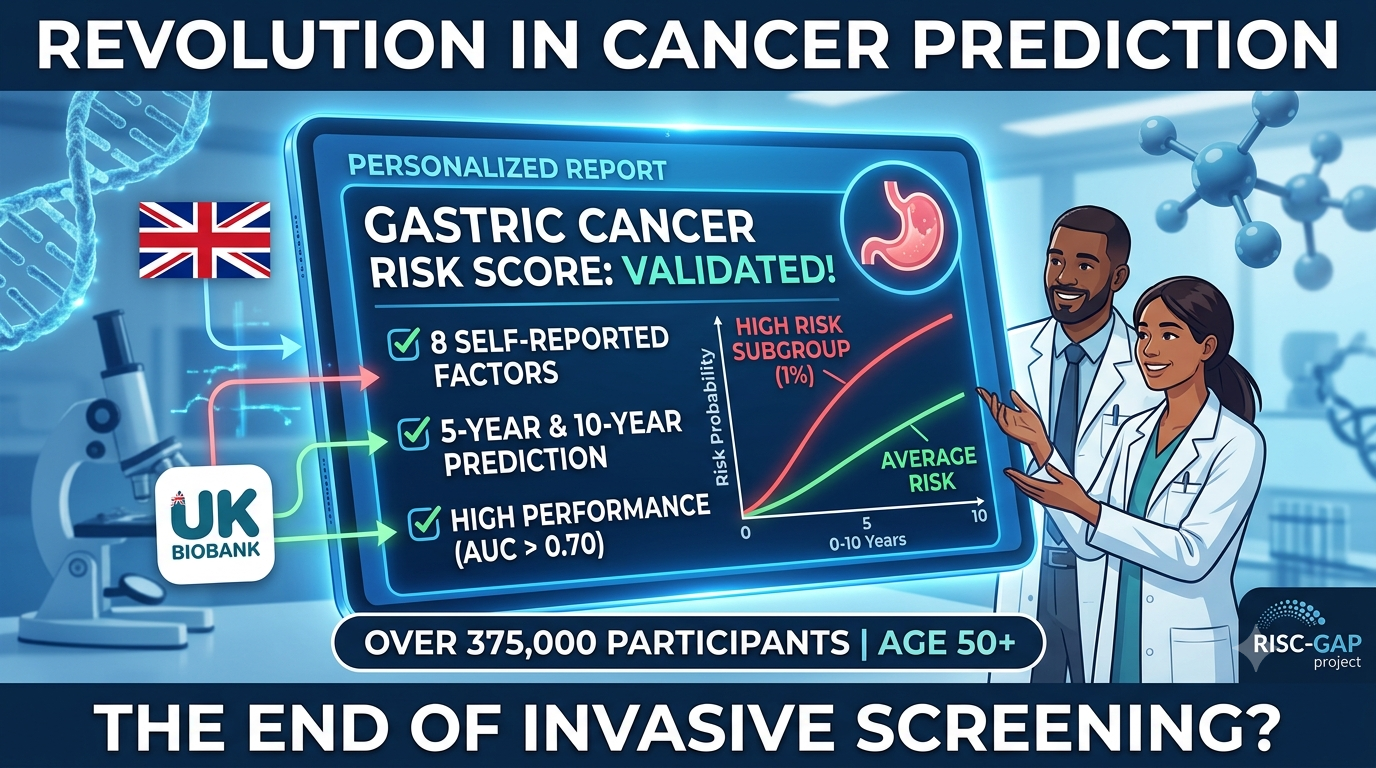
UK Biobank Validates Game-Changing 8-Step Risk Score for Gastric Cancer
Gastric (stomach) and esophageal cancers are among the most aggressive malignancies worldwide, often diagnosed late when treatment options are limited. However, a major breakthrough has emerged from Europe. Researchers working on the RISC-GAP project have developed and validated a pioneering, non-invasive risk score specifically designed to catch individuals at elevated risk of these upper gastrointestinal (UGI) cancers before symptoms appear.
Validated using an extensive database from 375,280 participants aged 50 and older within the UK Biobank, this new tool achieves something remarkable: it predicts a person’s 5-year and 10-year risk using only self-reported clinical and lifestyle data. No immediate blood draws, no expensive genetic sequencing, and no invasive endoscopies are required for the initial assessment.
Why This UK Biobank Validation Matters
Early detection of upper gastrointestinal cancers has traditionally been a medical bottleneck. Mass screening via endoscopy is highly effective in high-incidence countries like Japan and South Korea, but it is neither cost-effective nor ethically practical in low-to-middle incidence regions like Western Europe and North America.
The RISC-GAP project solves this problem with a two-step risk-stratified screening model:
- Step 1: Use a simple, non-invasive questionnaire (the newly validated risk score) to filter the general population aged over 50.
- Step 2: Fast-track individuals identified as “high risk” for advanced biomarkers and targeted clinical endoscopies.
By using the UK Biobank cohort—which features a robust median follow-up of 11.7 years—researchers have proven that basic, everyday health data can accurately isolate the small percentage of the population that genuinely needs urgent clinical attention.
The 8 Predictors Shaping the Risk Score
To make the screening tool as accessible as possible, researchers used advanced statistical modeling (Cox regression with LASSO penalization) to narrow down dozens of variables into just eight simple, self-reported predictors.
| Predictor Category | Specific Variable Analyzed |
|---|---|
| Demographics | • Biological Sex |
- Current Age |
| Lifestyle Choices | • Smoking Status (Never, Former, Current) - Alcohol Consumption Patterns |
| Physical Metrics | • Body Mass Index (BMI) |
| Medical History | • Prior history of Esophagitis (inflammation of the esophagus) - Previous surgeries involving the stomach or esophagus |
| Medication Use | • Regular use of gastric acid inhibitors (such as PPIs or H2 blockers) |
The 1% Threshold: The model successfully identified a high-risk subgroup defined by a 10-year absolute cancer risk threshold of at least 1%. While 1% sounds small, this subgroup accounts for roughly 6% of the overall population over 50 but holds a highly disproportionate number of future cancer cases.
Performance and Statistical Accuracy
The risk score demonstrated strong, reliable predictive power when put through rigorous 10-fold cross-validation:
- 5-Year Risk Prediction: Achieved an Area Under the Curve (AUC) of 0.740.
- 10-Year Risk Prediction: Achieved an Area Under the Curve (AUC) of 0.724.
In clinical predictive modeling, an AUC above 0.70 represents good discriminatory performance. This means the score is highly capable of distinguishing between an individual who will go on to develop gastric or esophageal cancer and one who will not, using nothing more than a checklist of eight questions.The Science of the Predictors: Why They Matter
1. Gastric Acid Inhibitors & Esophagitis
The inclusion of gastric acid inhibitors (like Proton Pump Inhibitors) and esophagitis highlights a crucial clinical link. Chronic acid reflux and tissue inflammation are well-known precursors to cellular changes, such as Barrett’s esophagus, which can rapidly transition into adenocarcinoma.
2. Metabolic Variables & Alcohol
This score aligns seamlessly with parallel research out of the UK Biobank showing that upper GI cancer risks spike significantly when metabolic dysfunction (tracked here via BMI) is combined with even minimal alcohol consumption.
3. The Role of Smoking and Gender
Biologically, males and individuals with long-term tobacco exposure experience vastly higher rates of upper GI tract malignancies. The RISC-GAP model heavily weighs these factors to ensure high-risk men aren’t missed during routine checkups.
Limitations and the Next Phase of RISC-GAP
While the validation is a major milestone for preventative medicine, the study’s authors point out a few key limitations:
- Geographic Focus: The model was built and validated using a single-country UK population, meaning it will need further evaluation before being rolled out in highly diverse international healthcare systems.
- Data Constraints: A few minor lifestyle and dietary predictors may have been missed due to the data boundaries within the UK Biobank registry.
What Comes Next?
The validation of this self-reported score is only phase one. The researchers behind the RISC-GAP project are already working on the next evolution of the tool. Future iterations will evaluate whether blending this basic 8-variable questionnaire with circulating blood biomarkers (like specific fatty acids or metabolite panels) and polygenic risk scores (PRS) can push the predictive AUC even closer to perfection.
The Public Health Impact
If successfully integrated into primary care, this questionnaire could completely reshape how gastrointestinal oncology is handled. Instead of waiting for a patient to present with advanced symptoms like difficulty swallowing or sudden weight loss, family physicians could run this calculation during routine wellness visits for patients over 50.
By identifying the 6% of the population sitting in the high-risk zone, healthcare systems can deploy expensive endoscopic resources precisely where they are needed most—saving lives through early intervention while drastically cutting down on unnecessary medical procedures.